Your dentist has told you that a full arch of fixed implant teeth is the answer. Then the treatment plan raises a new question: four implants or six? Two more implants sounds like it must be better. It also means more surgery, and sometimes more bone than you have.
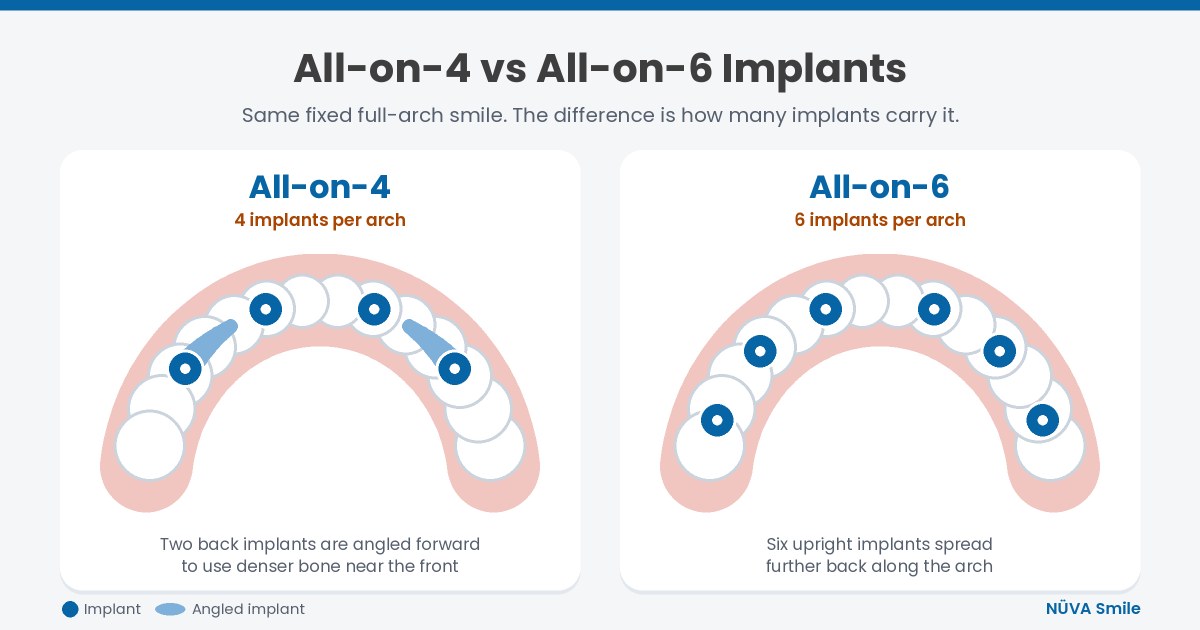
Here is the short answer. All-on-4 and All-on-6 give you the same result: a full arch of fixed teeth that never come out. All-on-4 uses four implants, with the two back implants angled to make the most of the bone near the front of your jaw. All-on-6 adds two implants further back, which spreads your bite over more support but needs more bone. Long-term studies show similar success for both. Your bone, the jaw being treated and how hard you bite decide which plan fits.
This guide compares them side by side so you can walk into your consultation knowing what to ask. If you’re still deciding between implants and a denture, read our guides to All-on-4 or snap-in dentures and All-on-4 or traditional dentures.
How Do All-on-4 and All-on-6 Implants Compare?
| All-on-4 Implants | All-on-6 Implants | |
| Cost | Call for pricing. Usually a lower investment than All-on-6, because fewer implants are placed. | Call for pricing. Usually a higher investment, because two more implants are placed. Any bone grafting adds to the plan. |
| Treatment Time | One surgery, often on the same day as any extractions. Many patients leave with fixed temporary teeth that day. Final teeth follow after a few months of healing. | One surgery, slightly longer than All-on-4. Same-day temporary teeth are often possible. If the back of the jaw needs a bone graft or sinus lift first, add several months. |
| Lifespan | Implants can last for decades with good care. Studies following patients for up to 13 years show similar survival for both options. The bridge may need repair or replacement after many years. | Implants can last for decades with good care. In the upper jaw, research links six implants to less bone loss around the implants over time. The bridge may need repair or replacement after many years. |
| Pain / Recovery | Minor oral surgery at four implant sites. Expect soreness and swelling for a few days, then a soft diet while the implants heal. | Minor oral surgery at six implant sites, so some patients notice a little more soreness. Recovery is otherwise similar, unless grafting is needed, which adds healing time. |
| Best Candidate | Missing or losing most teeth in an arch, has lost bone at the back of the jaw, and wants to avoid bone grafting. | Has enough bone along the whole arch, is restoring the softer upper jaw, has a large arch, or grinds or bites heavily. |
What Are All-on-4 Dental Implants?

All-on-4® replaces a full arch of teeth using four dental implants. The two front implants are placed straight. The two back implants are angled forward, often by 30 to 45 degrees, so they anchor in the denser bone toward the front of the jaw and steer clear of the sinuses in the upper jaw and the main nerve in the lower jaw. That angle is why many patients with bone loss can skip bone grafting.
The bridge of teeth is fixed. You don’t take it out at night, and you never need adhesive. Only your dentist can remove it, usually during maintenance visits. Learn more on our All-on-4 dental implants page.
What Are All-on-6 Dental Implants?
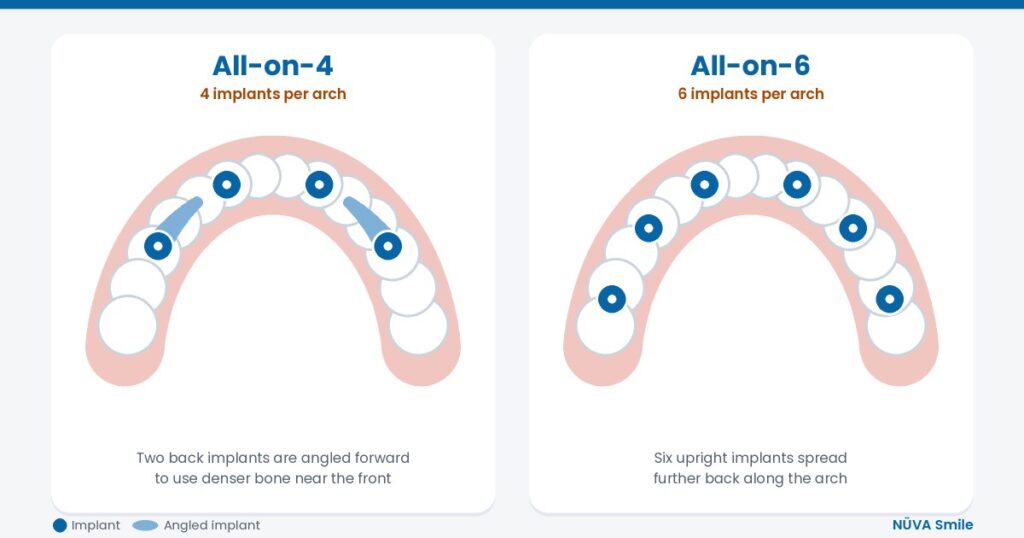
All-on-6 follows the same idea with six implants per arch. The implants are usually placed upright and spread further back along the jaw, so the bridge has more support under the back teeth. Each implant carries roughly two teeth of the bridge instead of three.
Six implants need more room. The back of the upper jaw often has less bone because the sinuses expand after teeth are lost, so some patients need a sinus lift or bone graft before All-on-6 is possible. You may also see the term All-on-X, which means the number of implants is chosen for each patient, commonly four, five or six. Our dental implants page covers the implant options we offer.
What Are the Differences Between All-on-4 and All-on-6?
All-on-4 and All-on-6 differ in six ways: the number and angle of the implants, the amount of jawbone each needs, the jaw each suits best, the support under the back teeth, what happens if an implant fails, and the length of treatment. The end result is the same in both: a fixed full-arch bridge of teeth that only your dentist can remove.
How Do All-on-4 and All-on-6 Differ in Implant Number and Angle?
All-on-4 relies on four implants, two of them tilted. All-on-6 uses six, usually upright. Tilting lets the surgeon place longer implants in limited bone. Adding implants gives the bridge more anchor points. Both approaches hold the same kind of fixed, full-arch bridge.
How Much Jawbone Do All-on-4 and All-on-6 Need?
All-on-4 was designed for people who have lost bone at the back of the jaw. By angling the back implants, it often avoids grafting altogether. All-on-6 needs enough bone height and width at six sites, including further back. If that bone is missing, your plan may include a bone graft or a sinus lift, which adds a procedure and several months to treatment. A 3D cone beam CT scan at your consultation shows exactly how much bone you have and where.
Is All-on-4 or All-on-6 Better for the Upper or Lower Jaw?
The upper jaw has softer, more porous bone than the lower jaw. One imaging study measured the lower jaw at about 1.8 times the mineral density of the upper jaw. Softer bone grips each implant less firmly, so many implant dentists favor six implants for an upper arch when the bone allows, and four for a lower arch. Each arch is planned on its own, so a plan can use six implants on top and four on the bottom.
Does All-on-6 Support the Back Teeth Better Than All-on-4?
Your back teeth take the most force when you chew. With All-on-4, the last teeth on the bridge often extend past the back implants, like a short diving board. Dentists call this extension a cantilever. All-on-6 places implants further back, so the back teeth sit closer to direct support. This matters most if you grind your teeth or have a heavy bite.
What Happens If an All-on-4 or All-on-6 Implant Fails?
Implant failure is uncommon with both All-on-4 and All-on-6, and long-term studies show no significant difference between them in implant or bridge survival. If an implant does fail, your dentist plans a replacement implant or an adjustment to the bridge, depending on where the implant was and how much bone remains. Ask how this would be handled in your plan, and whether you would need a temporary bridge while a new implant heals.
How Long Do All-on-4 and All-on-6 Treatments Take?
Both can be teeth-in-a-day treatments. Failing teeth are removed, the implants are placed and a fixed temporary bridge is attached in the same visit, as long as the implants are stable enough. Your final bridge is made after a few months of healing. All-on-6 surgery takes a little longer, and any grafting extends the overall timeline. Learn more about same-day dental implants.
What Does Research Say About All-on-4 vs All-on-6 Survival?
Researchers have compared four and six implants for years, and the findings are reassuring for both options:
- A study of 217 patients followed for 3 to 13 years found no significant overall difference in implant survival between All-on-4 and All-on-6. Six implants performed more predictably for some higher-risk patients.
- A 2024 review of upper-jaw cases found similar implant and bridge survival, but more bone loss around the implants when only four were used.
- A 2025 study of 943 patients reported comparable implant survival at 2 and 5 years.
Neither option wins for everyone. The better plan is the one that fits your bone, your jaw and your bite.
Who Is a Good Candidate for All-on-4 vs All-on-6?
All-on-4 may be the better choice if you:
- Have lost bone at the back of your jaw
- Want to avoid bone grafting or a sinus lift
- Are restoring your lower jaw, where bone is denser
- Want fewer implant sites and a shorter surgery
- Prefer a lower upfront investment
All-on-6 may be the better choice if you:
- Have enough bone along the whole arch
- Are restoring your upper jaw, where bone is softer
- Grind your teeth or have a strong bite
- Have a large arch that needs support further back
- Are older or have low bone density, where research found six implants more predictable
Your jawbone, gum health and medical history decide what’s possible. Both options are part of our restorative dentistry care, and your dentist will recommend an implant number after reviewing your 3D scan.
What Should You Ask Your Dentist About All-on-4 and All-on-6?
- How much bone do I have at the back of my jaw?
- Would All-on-6 need a bone graft or sinus lift in my case?
- Can I leave with fixed teeth on the day of surgery?
- What happens if one of my implants fails?
- What material will my final bridge be made from?
- How often will I need maintenance visits?
Frequently Asked Questions About All-on-4 and All-on-6
Patients choosing between All-on-4 and All-on-6 most often ask about strength, lifespan, bone grafting, same-day teeth, recovery, All-on-X and cost. Short answers to each follow.
What is the difference between All-on-4 and All-on-6?
The number of implants. All-on-4 uses four implants, with the back two angled to use bone near the front of the jaw. All-on-6 uses six implants spread further back. Both hold a fixed full arch of teeth.
Is All-on-6 better than All-on-4?
Not for everyone. Long-term studies show similar implant survival for both. All-on-6 adds support and may suit the softer upper jaw or people who bite hard, while All-on-4 often avoids bone grafting when bone is limited.
Which lasts longer, All-on-4 or All-on-6?
With good care, the implants for both can last for decades, and studies following patients for up to 13 years show similar survival. In the upper jaw, six implants are linked to less bone loss around the implants over time.
Do I need bone grafting for All-on-6?
Sometimes. All-on-6 needs enough bone at six sites, including the back of the jaw. If bone is missing there, a bone graft or sinus lift may be needed first. All-on-4 often avoids grafting by angling the back implants.
Can I get teeth in one day with All-on-6?
Often, yes. If the implants are stable when they are placed, a fixed temporary bridge can be attached the same day with both All-on-4 and All-on-6. Your final teeth are made after the implants heal.
Is All-on-6 more painful than All-on-4?
Recovery is similar. All-on-6 involves two more implant sites, so some patients feel a little more soreness for a few days. Bone grafting, if needed, adds healing time.
What does All-on-X mean?
All-on-X means the number of implants is chosen for each patient instead of being fixed at four or six. Your dentist picks the number based on your bone, your jaw and your bite.
How much do All-on-4 and All-on-6 cost?
Cost depends on your treatment plan, including how many implants you need, any grafting and the material of your bridge. Call your nearest NÜVA Smile office for pricing.
Where Can You Get All-on-4 or All-on-6 Implants in New Jersey?
Not sure which is right for you? Schedule a consultation at your nearest NÜVA Smile location.