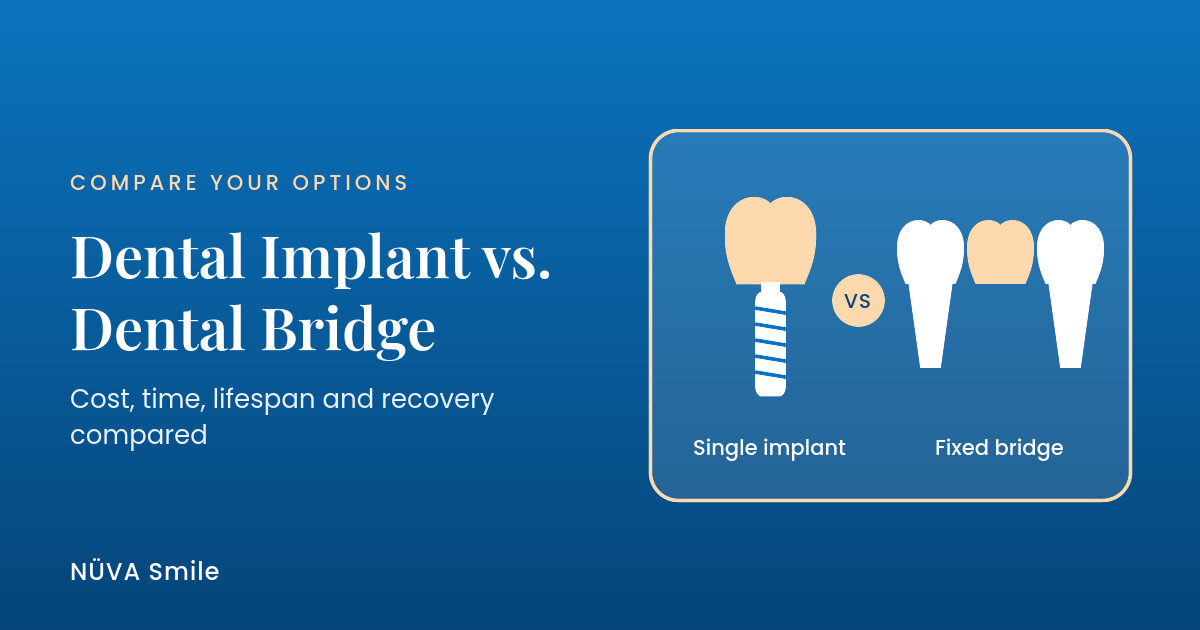
You have a missing tooth, and your dentist says there are two good ways to replace it: a single dental implant or a fixed dental bridge. Both fill the gap and restore your bite, but they work very differently. An implant is anchored in your jawbone. A bridge is anchored to the teeth on either side of the gap.
The right choice depends on your teeth, your jawbone, your health and your timeline. This guide compares the two side by side so you can walk into your consultation knowing what to ask. Both are part of our restorative dentistry care.
Dental Implant vs. Dental Bridge at a Glance
| Single Dental Implant | Fixed Dental Bridge | |
| Cost | Call for pricing. Higher upfront investment, and the implant itself can last for decades. | Call for pricing. Lower upfront cost, but a bridge may need to be replaced over time. |
| Treatment Time | Longer. The implant is placed, then heals for a few months before the final crown is attached. | Shorter. Usually two visits over a few weeks, with a temporary bridge in between. |
| Lifespan | The implant post can last for decades and often a lifetime. The crown on top may need replacement over the years. | Many last 10 years or more with good care, but replacement after 5 to 7 years is not uncommon. |
| Pain / Recovery | Minor oral surgery done with anesthesia. Expect mild soreness for a few days, usually managed with over-the-counter pain relievers. | No surgery. Local anesthetic keeps you comfortable, and the prepared teeth may feel sensitive for a short time. |
| Best Candidate | Healthy gums, enough jawbone (or a bone graft) and good overall health. A strong fit if you want to leave neighboring teeth untouched. | Healthy neighboring teeth that can support crowns, or teeth that already need crowns. A good fit if surgery is not right for you or you want faster results. |
What Is a Single Dental Implant?
A single dental implant replaces both the root and the crown of one missing tooth. A small titanium post is placed in the jawbone. Once it has healed, it is topped with a custom crown that looks and works like a natural tooth.
Because the implant stands on its own, it does not change the healthy teeth beside it. It also acts like a natural root, which helps protect the jawbone from the bone loss that can follow tooth loss. Learn more on our dental implants page.
What Is a Fixed Dental Bridge?
A fixed dental bridge replaces a missing tooth with an artificial tooth held in place by crowns on the teeth next to the gap. There is no surgery, and the bridge is usually finished in about two visits. You wear a temporary bridge while the permanent one is made.
The trade-off is that a traditional bridge needs the neighboring teeth to be reshaped to hold the crowns. See our dental bridges page for how we plan and place them.
The Differences That Matter Most
- Neighboring teeth: an implant leaves them alone. A traditional bridge removes some healthy tooth structure to fit the crowns.
- Jawbone: an implant sits in the bone and helps keep it stimulated. A bridge rests above the gap and does not replace the root.
- Cleaning: an implant crown is cleaned like a natural tooth. Under a bridge, floss cannot pass between the connected teeth, so you need floss threaders or a water flosser.
- Surgery: an implant needs minor oral surgery. A bridge does not.
Which Option Is Right for You?
An implant may be a better fit if you:
- Want to protect your healthy neighboring teeth
- Have healthy gums and enough jawbone, or are open to a bone graft first
- Want a replacement built to last for decades
- Are comfortable with a longer treatment timeline
A bridge may be a better fit if you:
- Have neighboring teeth that already need crowns or large repairs
- Prefer to avoid surgery, or have a health condition that makes surgery risky
- Want your tooth replaced in fewer weeks
- Want to start with a lower upfront investment
Smoking and uncontrolled diabetes can raise the risk of implant complications, so tell your dentist about your health history. If your jawbone is thin, a bone graft can often rebuild the area. Only an exam can show which option fits you.
Frequently Asked Questions
Is a dental implant better than a bridge?
Neither option is best for everyone. An implant protects neighboring teeth and can last longer. A bridge is quicker, needs no surgery and costs less upfront. The right choice depends on your teeth, bone and health.
Which is more painful, an implant or a bridge?
Both are done with anesthesia, so you should not feel pain during the procedure. An implant involves minor surgery, so expect mild soreness for a few days, usually managed with over-the-counter pain relievers. A bridge involves no surgery, though the prepared teeth may feel sensitive for a short time.
How long do dental bridges and implants last?
Many bridges last 10 years or more with good care, though replacement after 5 to 7 years is not uncommon. The titanium post of an implant can last for decades and often a lifetime, while the crown on top may need replacement over time.
Does a bridge damage the teeth next to it?
A traditional bridge needs the neighboring teeth to be reshaped so crowns can fit over them. That removes some healthy tooth structure and cannot be undone, which is why many patients choose an implant to protect those teeth.
Can I get an implant if I already have a bridge?
In many cases, yes. Your dentist will check your gums and jawbone to see whether an implant is possible. If bone has been lost, a bone graft may be needed first.
How much does an implant cost compared to a bridge?
Costs depend on your treatment needs, so we give pricing after an exam. Call your nearest NÜVA Smile office for pricing.
Find Your Best Option
Your dentist can examine your teeth, gums and jawbone and explain which option fits your situation. Not sure which is right for you? Schedule a consultation at your nearest NÜVA Smile location.